All Articles
Clear, original explainers across investing, personal finance, taxes, markets, and trading education.
55 articles

Personal Finance
How Much of Your Salary Should Go Towards a Home EMI?
A practical Indian guide to choosing an affordable home EMI using take-home pay, other debts, emergency reserves, interest-rate stress tests, and long-term goals.
12 min read

Personal Finance
Rent vs Buy vs Build a House: How to Decide
Renting, buying, and building solve different problems. Compare their full costs, flexibility, risks, and lifestyle trade-offs before choosing a home.
13 min read

Personal Finance
Health Insurance in India: A Practical Guide for Families
How to compare health insurance beyond the premium: sum insured, room-rent limits, co-pay, waiting periods, exclusions, restoration, hospital networks, and super top-ups.
11 min read

Investing
Physical Gold vs Gold ETF vs Sovereign Gold Bond
Jewellery, coins, Gold ETFs, and Sovereign Gold Bonds all provide different kinds of gold exposure. Compare liquidity, costs, purity, income, and practical risks.
11 min read

Investing
IPO Investing for Beginners: Read This Before You Apply
Understand price bands, ASBA, allotment, listing gains, offer documents, and the questions to ask before applying for an IPO in India.
11 min read

Investing
What Is an Index Fund? How to Choose One in India
What an index fund means in India, how a Nifty 50 index fund works, and how to compare indices, tracking difference, costs, direct plans, and fund formats.
10 min read

Investing
How Indians Can Invest in US Markets
Compare India-domiciled international funds with direct overseas investing under LRS, including currency risk, costs, taxes, reporting, and portfolio fit.
12 min read

Investing
Demat Account Charges Explained: The Costs Behind Zero Brokerage
Zero brokerage does not always mean zero cost. Learn about AMC, DP charges, taxes, exchange fees, pledging costs, and how to compare demat accounts fairly.
9 min read

Investing
Asset Allocation for Beginners: Build a Portfolio Around Your Goals
Learn how to divide money among equity, debt, cash, and gold using goals, time horizon, risk capacity, and a simple rebalancing process.
11 min read

Personal Finance
Term Insurance vs Endowment Policy: Cover and Returns Explained
Term insurance focuses on life cover, while endowment policies combine insurance with savings. Learn why mixing protection and returns can leave families under-insured.
9 min read

Personal Finance
Why Insurance and Investment Should Usually Be Kept Separate
Insurance protects your family from financial shocks. Investments grow money for goals. Learn why combining the two can make both decisions less clear.
9 min read

Investing
ULIP vs Mutual Fund: Insurance Plus Investing or Pure Investing?
ULIPs combine insurance and market-linked investment, while mutual funds are pure investment products. Learn the key differences before deciding.
9 min read

Investing
Open-Ended vs Close-Ended Mutual Funds: What Changes for Investors?
Open-ended and close-ended mutual funds differ in liquidity, entry, exit, and pricing. Learn how they work before choosing a fund.
8 min read

Investing
What Is NAV in Mutual Funds? Expense Ratio and Exit Load Explained
NAV full form, NAV calculation, expense ratio, and exit load explained with simple examples for Indian mutual fund investors.
8 min read

Futures & Options
Put Option Explained: Put Buy vs Put Sell
A put option gains value when the underlying falls. Learn put buying, put selling, hedging use cases, and the risks of short puts.
10 min read

Futures & Options
Futures and Options Basics: What F&O Means in the Stock Market
Futures and options are derivative contracts that get their value from an underlying asset. Learn the basics, uses, and risks before trading.
10 min read

Futures & Options
F&O Risk and Margin: Why Leverage Can Hurt Quickly
F&O margin makes large exposure possible with less cash, but leverage can magnify losses. Learn margin, mark-to-market, and risk controls.
10 min read
Futures & Options
Call Option Explained: Call Buy vs Call Sell
A call option gains value when the underlying rises. Learn what call buying and call selling mean, including payoff, premium, and risk.
10 min read

Futures & Options
Buying vs Selling Options: Premium, Probability, and Risk
Option buyers and sellers have very different payoff profiles. Learn how premium, time decay, probability, and margin change the trade.
10 min read

Economy & Markets
What Is the Yield Curve? Bond Yields Explained Simply
The yield curve compares short-term and long-term bond yields. Learn what normal, flat, and inverted curves can suggest about rates and growth.
9 min read

Economy & Markets
What Is Inflation? Meaning, Causes, and Impact on Your Money
Inflation is the rise in prices over time. Learn how it affects purchasing power, savings, loans, salaries, and investment returns in India.
9 min read
Economy & Markets
Real vs Nominal Returns: The Inflation Adjustment Investors Forget
A return can look attractive before inflation and weak after it. Learn the difference between nominal and real returns with simple examples.
8 min read
Economy & Markets
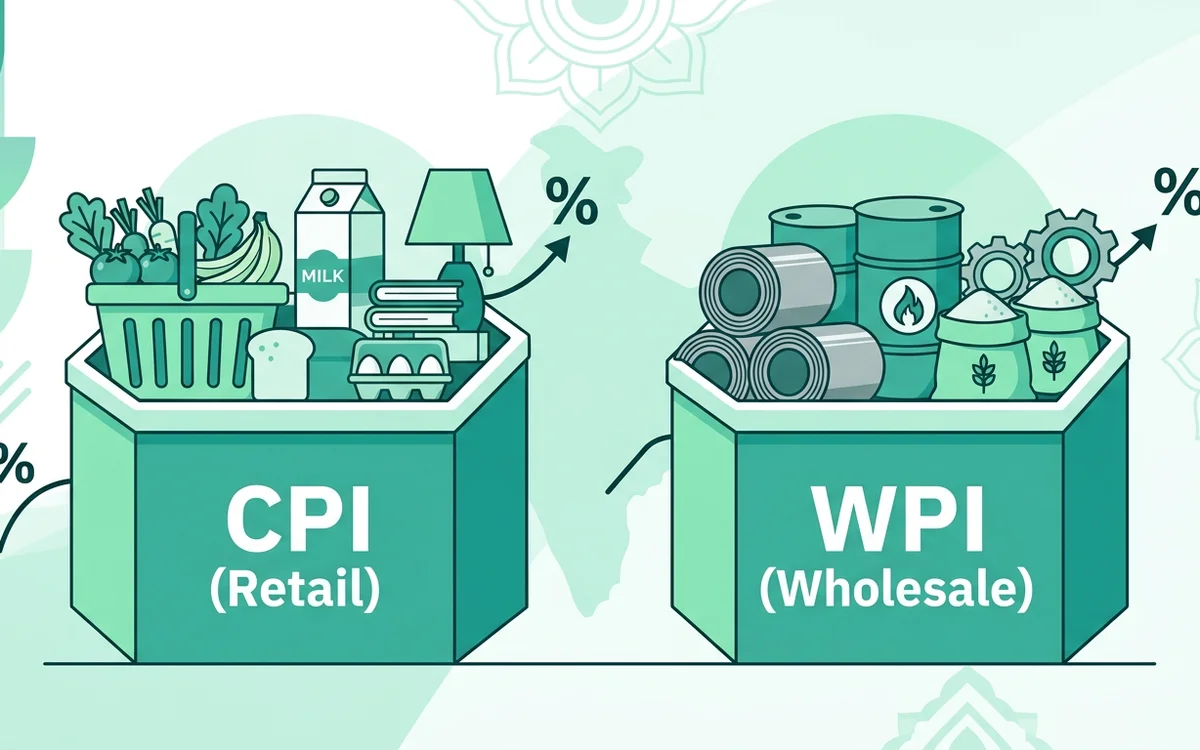
CPI vs WPI Inflation in India: What Is the Difference?
CPI and WPI both measure price changes, but they track different baskets. Learn which one matters more for households and monetary policy.
8 min read

Technical Indicators
VWAP (Volume Weighted Average Price), Explained
VWAP blends price and volume into a single intraday benchmark that big institutions watch closely. Here's how it's calculated, how it's used, and its limits.
8 min read

Technical Indicators
Support and Resistance, Explained
Support and resistance are the floors and ceilings of a price chart — the most fundamental idea in technical analysis. Here's how they form, how they're used, and how they break.
8 min read

Technical Indicators
The Stochastic Oscillator, Explained
The Stochastic Oscillator measures where price closes within its recent range to gauge momentum. Here's how its %K and %D lines work — and why 'overbought' doesn't mean 'sell'.
9 min read

Technical Indicators
Margin and Leverage in Trading: How Losses Get Magnified
Leverage can multiply gains — and just as easily wipe out an account. Here's what margin and leverage really are, why they blow up traders, and the risk rules that keep accounts alive.
11 min read

Technical Indicators
Fibonacci Retracement, Explained
Fibonacci retracement marks potential pullback levels within a trend using ratios derived from a famous number sequence. Here's how it's drawn, read, and why it's not magic.
8 min read

Technical Indicators
Bollinger Bands, Explained: Volatility on a Chart
Bollinger Bands wrap price in a volatility envelope that widens and narrows with the market. Here's how they're built, what the 'squeeze' means, and where they mislead.
9 min read

Technical Indicators
ADX (Average Directional Index), Explained
The ADX measures how strong a trend is — but not which way it points. Here's how it works alongside its +DI and −DI lines, and how traders read trend strength.
8 min read

Personal Finance
Retirement Planning in India: A Complete Guide
How to work out the retirement corpus you'll actually need once inflation is factored in, the schemes that help you build it, and a step-by-step plan to get there.
12 min read

Investing
What Is a Bond? A Beginner's Guide for India
Bonds are how governments and companies borrow — and a core building block of a balanced portfolio. Here's how they work, the types available in India, and how to invest in them.
10 min read

Investing
Interest Rates, Inflation, and How They Affect Bonds
Why do bond prices fall when interest rates rise? How does inflation eat into your returns? A clear explanation of the forces that move fixed income.
10 min read

Investing
How to Start Investing in India: A Step-by-Step Beginner's Guide
A complete, practical walkthrough for first-time investors in India — from getting your finances ready to placing your first SIP, with a worked example and the mistakes to avoid.
11 min read

Technical Indicators
What Is Technical Analysis? A Plain-English Introduction
Technical analysis studies price and volume to understand market behaviour. Here's what it is, the ideas behind it, and — importantly — its limitations.
6 min read

Taxes
Old vs New Tax Regime, Explained
India runs two parallel income-tax systems. Here's the difference between the old and new regimes — and how to think about which suits you.
8 min read

Personal Finance
How Much Should You Really Keep in an Emergency Fund?
An emergency fund is the foundation of personal finance. Here's how to size yours, where to keep it, and how to build it without straining your budget.
6 min read

Technical Indicators
Moving Averages Explained: SMA vs EMA
The moving average is the most widely used indicator of all. Here's how the simple and exponential versions are built, and how they differ.
6 min read

Taxes
Income Tax Slabs Explained: How Slab Taxation Works
A clear explanation of how India's slab-based income tax works — including the common myth about moving into a higher tax bracket.
8 min read

Personal Finance
The 50/30/20 Budgeting Rule for Indian Incomes
A simple framework for splitting your take-home pay into needs, wants, and savings — and how to adapt it to real Indian living costs.
6 min read

Investing
What Is a Mutual Fund? A Beginner's Guide for India
A plain-English explanation of how mutual funds work in India — what they are, how you make (or lose) money, the main types, and the costs to watch.
7 min read

Technical Indicators
RSI (Relative Strength Index), Explained
The RSI is a momentum gauge that runs from 0 to 100. Here's how it's calculated, what 'overbought' and 'oversold' mean, and where it misleads.
6 min read

Taxes
Section 80C and Its 2026 Replacement: Tax-Saving Investments Explained
Section 80C remains relevant for FY 2025-26 returns, while the Income Tax Act, 2025 uses new section numbering from Tax Year 2026-27. Here's how the transition works.
8 min read

Personal Finance
How Your CIBIL Score Works (and How to Improve It)
Your credit score quietly shapes whether you get loans and at what rate. Here's what goes into a CIBIL score and how to build a healthy one.
6 min read

Investing
SIP vs Lump Sum: Which Way to Invest Is Better?
Should you invest a little every month or a big amount at once? How SIPs and lump-sum investing differ, and when each one makes sense.
6 min read

Technical Indicators
MACD Explained: Moving Average Convergence Divergence
The MACD combines two moving averages into a single momentum indicator. Here's how its line, signal, and histogram are built — and how they're read.
6 min read

Taxes
Capital Gains Tax in India: LTCG vs STCG (the Concept)
When you sell an asset for a profit, that gain may be taxed. Here's the concept of capital gains, and how short-term and long-term differ.
8 min read

Personal Finance
Term Insurance Basics: How Much Cover Do You Need?
Term insurance is generally the simplest, lowest-cost way to protect dependents. Here's how it works and how to estimate cover from your family's real needs.
9 min read

Investing
Direct vs Regular Mutual Fund Plans: What's the Difference?
Every mutual fund comes in two versions — direct and regular. The difference is a commission that can quietly cost you lakhs over the long run.
5 min read

Personal Finance
PPF vs EPF vs NPS: How India's Retirement Schemes Compare
Three of India's most popular long-term savings schemes, side by side — what each is, who it's for, and how lock-in and returns differ.
9 min read

Investing
Index Funds vs. Active Funds: Which Wins Over Time?
A clear look at costs, returns, and why low-cost index investing has quietly beaten most active managers — and the cases where active still has a role.
6 min read

Investing
ETF vs Mutual Fund: What's the Difference?
ETFs and index mutual funds can track the same index, yet they trade and cost differently. Here's how to tell them apart and when each suits you.
6 min read

Investing
Large-cap, Mid-cap & Small-cap Funds: What's the Difference?
Market capitalisation decides how Indian equity funds are categorised — and how risky they tend to be. Here's what large, mid, and small-cap really mean.
6 min read

Investing
What Is a Demat Account & How Does the Stock Market Work?
Before you can buy a single share in India, you need a demat account. Here's what it is, how it pairs with a trading account, and how the NSE and BSE actually work.
7 min read

Investing
The Power of Compounding: Start Early, Retire Richer
Why a decade of head start can do more for your retirement corpus than years of higher contributions later, explained with real numbers.
7 min read