What Is Technical Analysis? A Plain-English Introduction
Technical analysis studies price and volume to understand market behaviour. Here's what it is, the ideas behind it, and — importantly — its limitations.
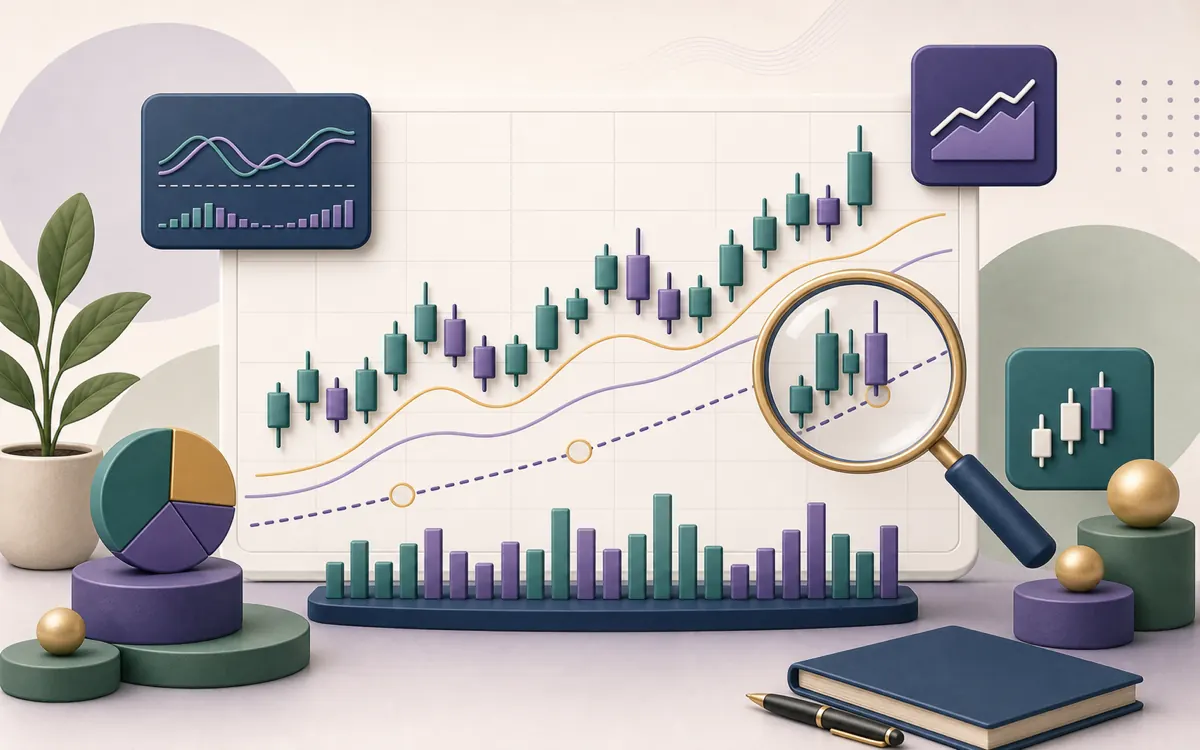
If you have ever looked at a stock chart covered in lines and wondered what it all means, you have met technical analysis. It is a way of studying markets that focuses on price movement itself, and it has its own vocabulary worth understanding — even if you never use it to trade.
Technical vs fundamental analysis
There are two broad schools of market analysis.
A fundamental analyst asks "what is this business worth?" A technical analyst asks "what is the price doing, and what does that suggest about supply and demand?" Many market participants use a mix of both.
The core ideas
Technical analysis rests on a few founding assumptions:
- Price reflects information. Followers argue that everything known about an asset — news, earnings, sentiment — is already expressed in its price.
- Prices move in trends. Rather than jumping randomly, prices are said to move in identifiable up-trends, down-trends, and sideways ranges.
- History tends to rhyme. Because markets are driven by human behaviour, recurring patterns are thought to appear again and again.
Common building blocks
A few concepts come up constantly:
- Support and resistance. Price levels where buying or selling has repeatedly emerged — support is a "floor," resistance a "ceiling."
- Trends and trendlines. Lines drawn to show the general direction of price over a period.
- Volume. The number of units traded, used to gauge how much conviction is behind a move.
- Indicators. Calculations applied to price or volume to summarise behaviour — such as moving averages, the RSI, and the MACD.
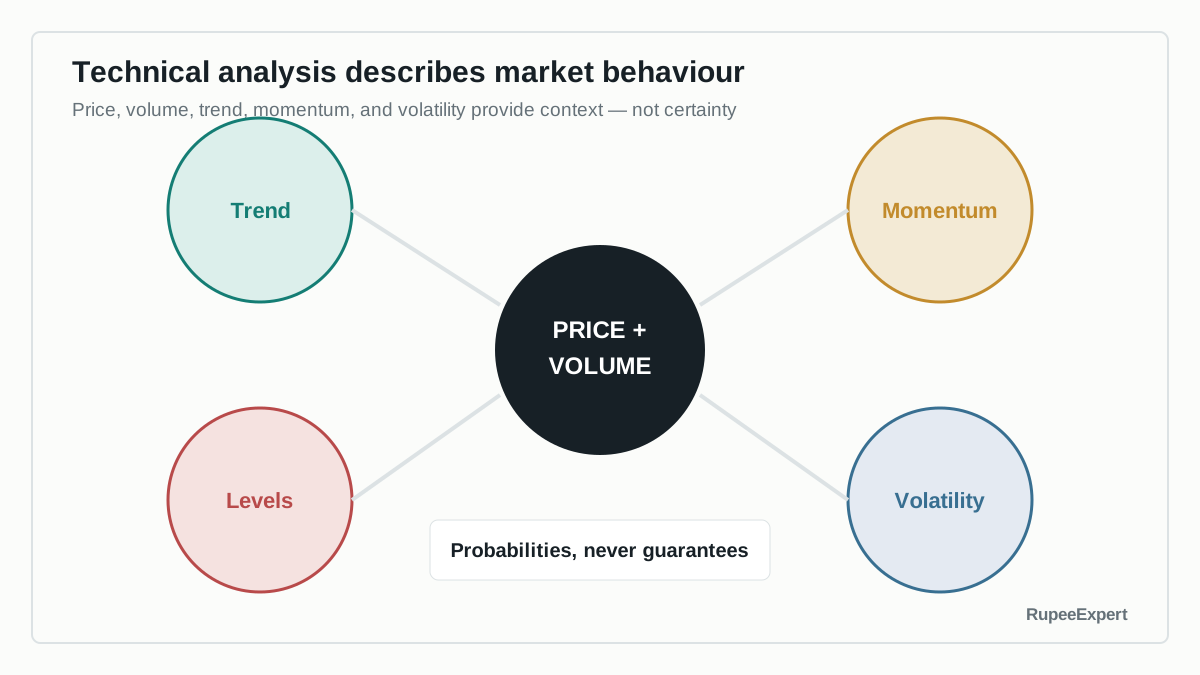
An indicator does not create independent evidence merely because it has a different name. RSI, MACD, and several moving-average tools all derive largely from the same price history. Combining them can produce the illusion of confirmation while counting the same information several times.
What technical analysis cannot do
This is the part that matters most. Technical analysis describes what has happened; it does not reliably predict what will happen.
- Indicators are calculated from past prices, so they inherently lag reality.
- Signals frequently fail — an indicator can flash "overbought" while a price keeps climbing for months.
- Some critics argue markets are efficient enough that chart patterns have no predictive edge, and that any apparent success is partly self-fulfilling or down to chance.
None of this means technical analysis is useless as a lens for understanding market behaviour. It means the signals are probabilities at best, never certainties.
Common mistakes to avoid
- Treating indicators as predictions. They describe past behaviour; they do not foretell the next move.
- Relying on a single indicator. Any one tool gives a narrow, often misleading picture in isolation.
- Forgetting that indicators lag. Built from past prices, they confirm moves after they begin.
- Mistaking a pattern for a certainty. Chart signals are probabilities, and they fail often.
Bottom line
Technical analysis is a framework for reading price and volume — a useful vocabulary for understanding how markets move. But indicators look backwards, give false signals, and guarantee nothing about the future. Everything in this section of RupeeExpert is here to explain how these tools work, not to tell you when to buy or sell anything.
Frequently asked questions
What is the difference between technical and fundamental analysis?
Fundamental analysis studies a company's underlying business — earnings, debt, growth — to estimate what it is worth. Technical analysis studies historical price and volume data on charts to understand how the market has behaved. Many participants use a mix of both.
Can technical analysis predict the future?
No. It describes what has happened, not what will happen. Indicators are calculated from past prices, so they lag, and their signals frequently fail. Treat them as probabilities at best, never certainties.
Is technical analysis reliable?
Its signals are tendencies, not guarantees. Some critics argue markets are efficient enough that chart patterns have little predictive edge, and that apparent success can be self-fulfilling or down to chance.
Do I need technical analysis to invest?
No. Many long-term investors rely on fundamentals, diversification, and low-cost funds without using technical analysis at all. It is one lens for understanding market behaviour, not a requirement.
Sources & further reading
Was this article helpful?