VWAP (Volume Weighted Average Price), Explained
VWAP blends price and volume into a single intraday benchmark that big institutions watch closely. Here's how it's calculated, how it's used, and its limits.
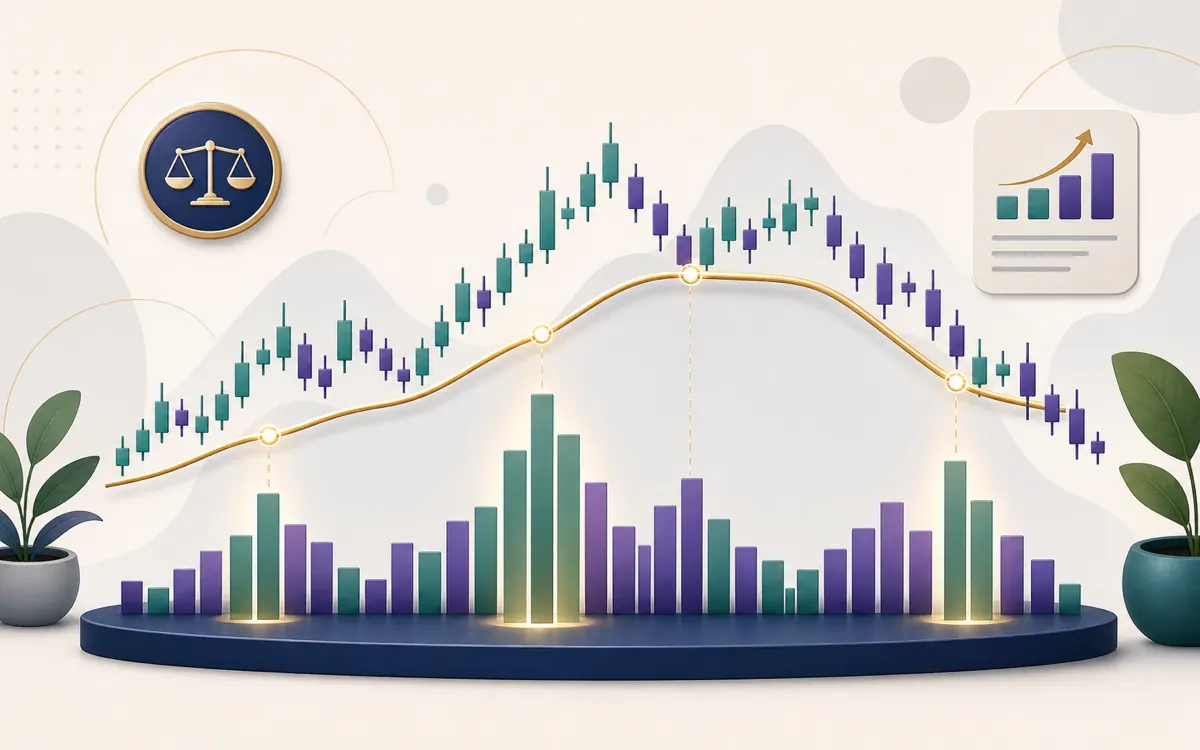
VWAP — the Volume Weighted Average Price — is a favourite of intraday traders and large institutions alike. Where a plain average treats every price equally, VWAP gives more weight to the prices where the most trading actually happened, producing a more representative "centre of gravity" for the day.
What VWAP is
Because it accounts for volume, VWAP answers a subtly different question from a moving average. A moving average asks "what was the average price?" VWAP asks "what was the average price people actually traded at?" — giving heavily traded prices more say.
How it's calculated
VWAP is a running, cumulative figure through the trading day:
Typical price = (High + Low + Close) / 3   (for each period)
VWAP = Σ (Typical price × Volume) / Σ (Volume)
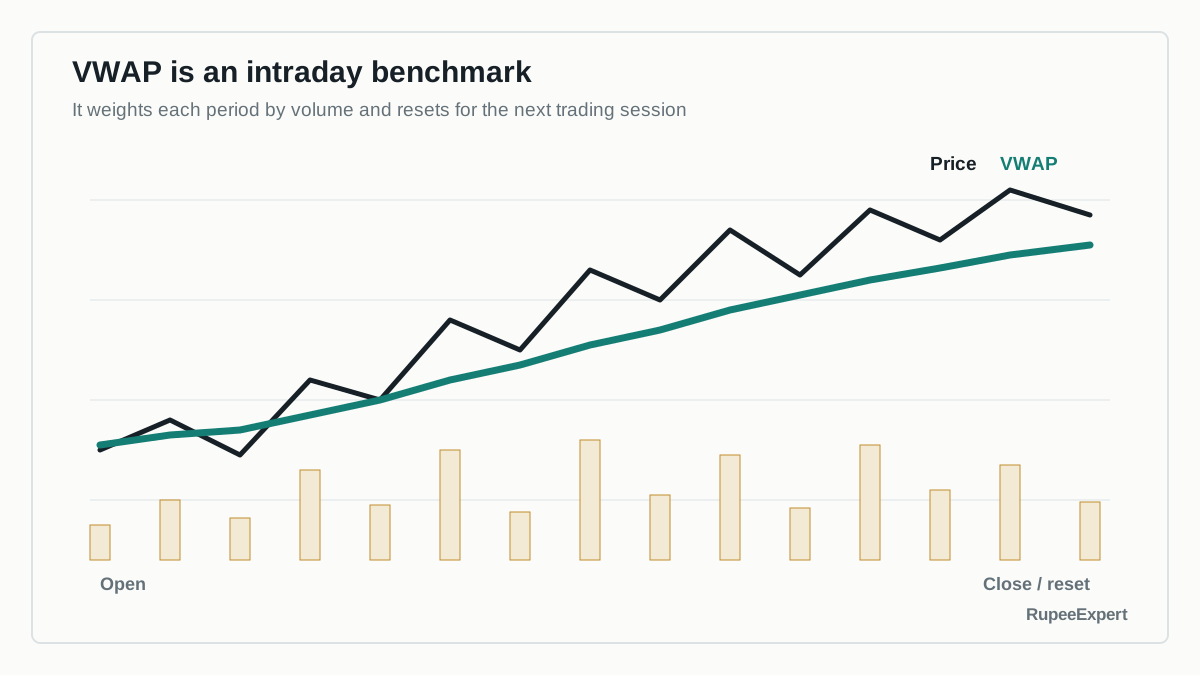
The sums accumulate from the start of the session, so VWAP at any moment reflects all of the day's trading up to that point. At the next day's open, it resets and starts again — which is why VWAP is fundamentally an intraday tool.
How traders use it
A few common readings:
- As a benchmark. Large institutions judge their execution against VWAP: buying below it or selling above it counts as a good fill.
- As a fair-value line. Price above VWAP suggests relative intraday strength; below it suggests weakness.
- As a mean-reversion reference. Some intraday traders watch how price behaves as it returns toward VWAP, treating the line as a magnet.
Standard VWAP starts at the session open. Anchored VWAP is a related but different tool that begins from a chosen event or date. Because the anchor is subjective, two charts can show different values. Do not apply an anchored interpretation to the standard daily-reset VWAP without saying so.
The limitations
VWAP is useful but narrow:
- It is intraday. Because it resets daily, VWAP is not designed for multi-day or long-term analysis the way a moving average is.
- It lags. Like all indicators, it is built from prices that have already happened.
- It is not a signal. "Above VWAP" or "below VWAP" is context about the day, not an instruction to act.
VWAP is most informative for short-term, intraday context — and far less relevant to a long-term investor.
Common mistakes to avoid
- Using VWAP for long-term decisions. It resets daily and is built for intraday use.
- Treating a VWAP cross as a signal. Crossing the line is noisy and unreliable on its own.
- Ignoring the trend. VWAP behaves very differently on a strong trending day versus a quiet, range-bound one.
Bottom line
VWAP blends price and volume into a single intraday benchmark that shows where the day's trading has really centred. It is invaluable for execution and intraday context, but it resets each day, lags the present, and signals nothing by itself. For a long-term investor it is mostly irrelevant; for a short-term trader it is one useful reference among several — never a standalone trigger. This is educational only, not a trading recommendation.
Frequently asked questions
What is the difference between VWAP and a moving average?
A simple moving average treats every period equally, while VWAP weights each price by the volume traded at it — so heavily traded prices count more. VWAP also typically resets each trading day, whereas a moving average rolls continuously.
Why do institutions care about VWAP?
Large investors use VWAP as a benchmark for execution quality. Buying below the day's VWAP or selling above it means they transacted better than the volume-weighted average, so VWAP is a common yardstick for whether a big order was filled well.
Is price above VWAP a buy signal?
No. Price trading above VWAP is often read as relative intraday strength and below it as weakness, but that is context, not a signal. Like all indicators, VWAP is built from past data and does not predict the next move.
Sources & further reading
Was this article helpful?