What Is a Demat Account & How Does the Stock Market Work?
Before you can buy a single share in India, you need a demat account. Here's what it is, how it pairs with a trading account, and how the NSE and BSE actually work.
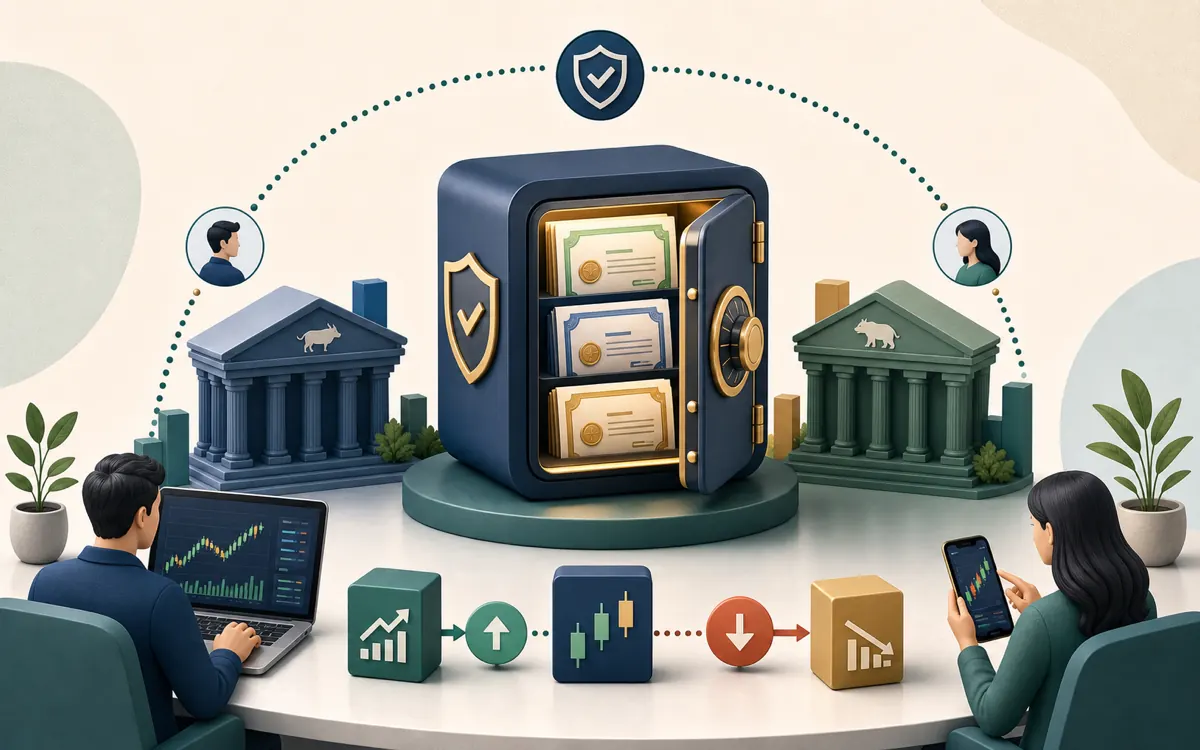
If you want to buy shares or ETFs directly in India, you cannot do it from your bank account alone. You need a specific set of accounts and a basic grasp of how the stock market is wired. The good news is that the system is simpler than the jargon makes it sound.
What a share is
A share (or stock) is a unit of ownership in a company. If a company has issued one crore shares and you own one hundred of them, you own a tiny fraction of that business. As the company's prospects change, the price others are willing to pay for your shares changes too — which is where gains and losses come from.
The two accounts you need
Buying shares involves two linked accounts that do different jobs:
In practice, brokers open both together. The flow is: money moves from your bank account through your trading account to buy shares, which are then delivered into your demat account. To sell, the reverse happens.
How the stock market works
India has two major stock exchanges: the National Stock Exchange (NSE) and the Bombay Stock Exchange (BSE). An exchange is essentially a regulated marketplace that matches buyers with sellers.
When you place an order to buy a share, the exchange's system matches it with someone willing to sell at that price. The headline indices you hear about — the Nifty 50 (NSE) and the Sensex (BSE) — simply track a basket of large companies to give a snapshot of how the broader market is moving.
What happens after you click "buy"
A trade does not finish instantly. After your order is matched, the trade goes through settlement, where shares and money actually change hands and the shares appear in your demat account. In India this typically completes very quickly — within a day of the trade — but it is a real process happening behind the scenes, run by clearing corporations and depositories.
Demat for shares vs mutual funds
One common point of confusion: you need a demat account to buy shares and ETFs, but you do not need one to buy a regular mutual fund, which you can purchase directly from the fund house. This is one of the practical differences between ETFs and index mutual funds.
A word of caution
Having a demat and trading account makes buying shares easy — sometimes too easy. Direct stock investing means picking individual companies and bearing the full ups and downs yourself, which is riskier than holding a diversified fund. The account is just a tool; using it well takes research and temperament. Nothing here is a recommendation to buy any particular stock.
Common mistakes to avoid
- Letting easy access encourage over-trading. Having the account makes buying simple — sometimes too simple.
- Picking individual stocks without research. Direct investing means bearing the full ups and downs yourself.
- Confusing the two accounts. The demat account holds shares; the trading account places orders — they do different jobs.
- Ignoring charges. Brokerage and other costs eat into returns, especially with frequent trading.
Bottom line
A demat account stores your shares, a trading account places your orders, and the NSE and BSE match buyers with sellers under SEBI's oversight. Once you understand that plumbing, the stock market stops feeling like a black box — and you can decide, on your own terms, whether direct investing is right for you.
Frequently asked questions
What is a demat account?
A demat (dematerialised) account holds your shares and other securities in electronic form, replacing old paper certificates. It is where your holdings actually sit.
Do I need a demat account to invest in mutual funds?
No. You need a demat account to hold shares and ETFs, but a regular mutual fund can be bought directly from the fund house without one.
What are the NSE and BSE?
The National Stock Exchange and the Bombay Stock Exchange are India's two major stock exchanges — regulated marketplaces that match buyers with sellers, overseen by SEBI.
How long does it take to receive shares after buying?
After your order is matched, the trade goes through settlement, where shares and money change hands and the shares appear in your demat account. In India this typically completes within a day of the trade.
Sources & further reading
Was this article helpful?