Margin and Leverage in Trading: How Losses Get Magnified
Leverage can multiply gains — and just as easily wipe out an account. Here's what margin and leverage really are, why they blow up traders, and the risk rules that keep accounts alive.
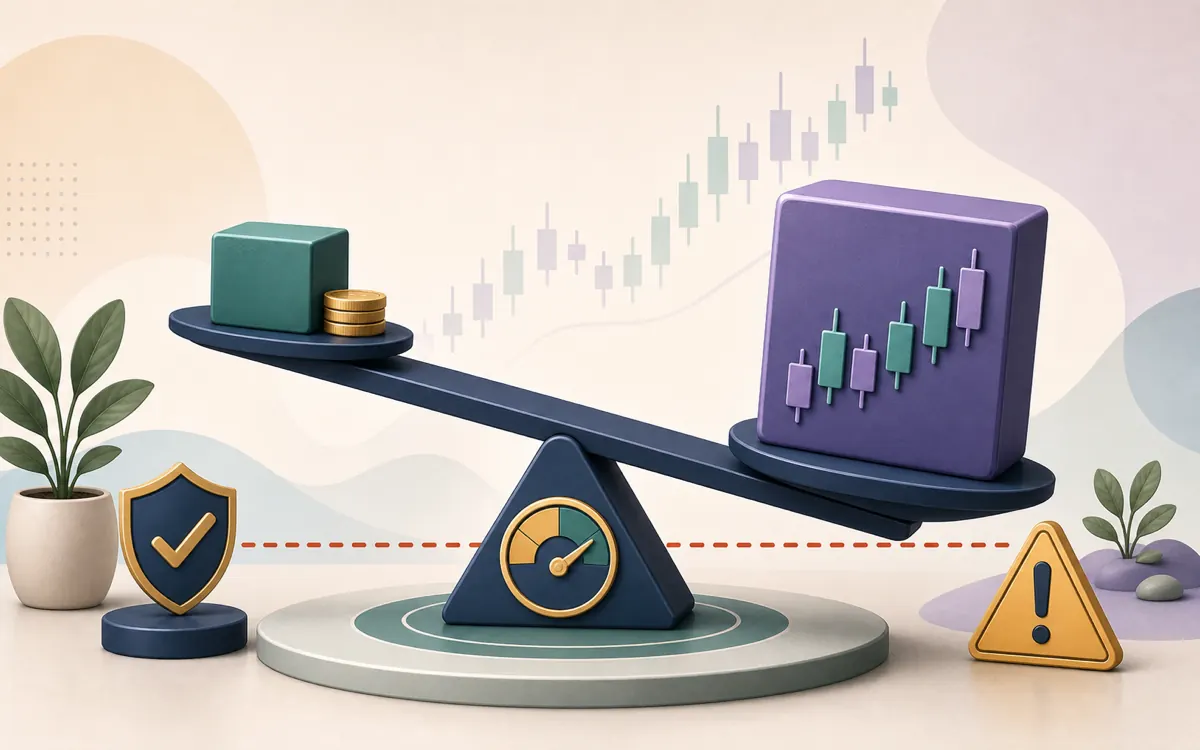
Leverage is one of the most seductive and most dangerous ideas in trading. The promise is intoxicating: control a large position with a small amount of money and multiply your returns. The reality, for most people who use it carelessly, is a wiped-out account. This article explains how it works and — more importantly — how not to let it destroy you.
What margin and leverage actually mean
The two terms are closely linked but distinct.
So margin is the deposit; leverage is the multiplier. Brokers offer leverage because it lets you trade bigger — and because bigger trades generate more brokerage. Whether it helps you is an entirely different question.
How leverage cuts both ways
Here is the part the marketing leaves out. Leverage magnifies losses exactly as much as gains.
Suppose you have ₹1,00,000 and use 5x leverage to control ₹5,00,000 of a stock.
- If the stock rises 10%, your position gains ₹50,000 — a 50% return on your ₹1,00,000. Wonderful.
- If the stock falls 10%, your position loses ₹50,000 — a 50% loss of your capital. Painful.
- If it falls 20%, you lose ₹1,00,000 — your entire capital is gone.
A move that would be a mild dip for a normal investor becomes a knockout blow for a leveraged one. The higher the leverage, the smaller the move needed to ruin you.
Why accounts blow up
When a leveraged position moves against you far enough, your margin is no longer enough to cover potential losses, and the broker steps in.
This forced closure (liquidation) is how accounts die. The trader is removed from the position right at the bottom, crystallising the loss, with no chance to recover if the price later bounces back. Leverage turns a temporary, survivable drawdown into a permanent, account-ending one.
The sobering data
This is not theoretical. India's market regulator, SEBI, has published studies on individual traders in the equity derivatives segment, where leverage is built in. Its July 2025 comparative study reported that nearly 91% of individual traders incurred net losses in FY 2025. That is a population-level result, not a forecast for every person, but it is an important base rate to understand before trading.
Read that again before you ever use leverage. The base rate of success is low, and leverage makes the losses faster and larger. Any honest discussion of leverage has to start from this fact, not from the dream of multiplied gains.
Using leverage responsibly — if at all
For most people, the right amount of leverage is none, especially while learning. But if it is used, survival depends entirely on risk management, not on picking winners. The tools below are what separate traders who last from those who blow up.
The core principles:
- Risk a tiny share of capital per trade. A common guideline is risking only 1–2% of your account on any single trade, so no one loss can seriously hurt you. With ₹1,00,000, that is ₹1,000–₹2,000 of risk per trade — which dictates how big your position and how tight your stop must be.
- Always use a stop-loss, and honour it. Decide your exit before you enter, and let it execute. Moving a stop to avoid a loss is how disasters begin.
- Size down, not up, with leverage. Higher leverage should mean smaller positions, not bigger bets. Most blow-ups come from doing the opposite.
- Never trade money you can't afford to lose. Leverage on borrowed or essential money is how people lose far more than their savings.
Rules that keep accounts alive
If you distil it down, surviving traders tend to follow a short, unglamorous checklist:
- Define your maximum loss per trade before entering.
- Use a stop-loss on every position.
- Keep per-trade risk to a small, fixed percentage of capital.
- Avoid over-leveraging — treat high leverage as a warning sign, not an opportunity.
- Accept losing streaks as inevitable and size so you can survive them.
- Keep trading capital separate from savings, emergency funds, and bills.
Notice that none of these are about predicting the market. They are about making sure that being wrong — which you will be, often — never ends the game.
Common mistakes that end accounts
- No stop-loss. Hoping a loser comes back is the classic account-killer.
- Over-sizing. Putting too much of your capital into one leveraged trade.
- Adding to losers. "Averaging down" with leverage multiplies the damage.
- Revenge trading. Trying to win back a loss with a bigger, riskier bet.
- Confusing leverage with skill. A few leveraged wins can feel like genius right up until the one trade that erases them all.
Bottom line
Margin and leverage let you control more than your money should allow — and that same power can erase your account in a single move. The data is blunt: most individual derivatives traders lose money, and leverage speeds up those losses. If you take nothing else from this, take this: protecting your capital comes first, second, and third; multiplying it is a distant fourth. For most people, learning without leverage — or not trading with it at all — is the wisest choice. Please read our Risk Warning too. This article is educational only and is not a recommendation to trade or to use leverage.
Frequently asked questions
What is the difference between margin and leverage?
Margin is the money you put up as collateral to open a larger position; leverage is the ratio between the position size and your own capital. If you control ₹5,00,000 with ₹1,00,000 of your own money, your margin is ₹1,00,000 and your leverage is 5x. They are two sides of the same mechanism.
Why do leveraged traders blow up their accounts?
Because leverage magnifies losses just as much as gains. With 5x leverage, a 20% move against you wipes out your entire capital. Combined with no stop-loss and over-sized positions, a single bad trade can end an account — which is exactly how most blow-ups happen.
How much should I risk per trade?
A widely cited risk-management guideline is to risk only a small fixed percentage of your capital on any single trade — often 1% to 2%. The idea is that no single loss should be able to seriously damage your account, so you can survive a losing streak, which every trader will face.
Is leverage suitable for beginners?
For most beginners, no. Regulatory data shows the majority of individual derivatives traders lose money, and leverage accelerates those losses. Many experienced people advise learning without leverage first, and treating leverage as an advanced tool to be used sparingly, if at all.
Sources & further reading
Was this article helpful?