How Much of Your Salary Should Go Towards a Home EMI?
A practical Indian guide to choosing an affordable home EMI using take-home pay, other debts, emergency reserves, interest-rate stress tests, and long-term goals.

A bank may tell you how much it is willing to lend. That does not tell you how much your household can comfortably repay for the next 15, 20, or 25 years.
Home-loan eligibility is a lender's credit decision. Home-loan affordability is a household cash-flow decision. The two numbers can be very different.
The right EMI is one that still leaves room for food, school fees, healthcare, insurance, maintenance, emergencies, retirement, and an ordinary life. It should also remain manageable if a floating interest rate rises or income is temporarily disrupted.
The short answer: use 30% as a reference, not a rule
An RBI Bulletin research article illustrates housing affordability using an EMI-to-monthly-income measure below 30%. That makes 30% a useful reference point, but it is not a regulatory cap, a bank approval rule, or proof that every EMI below it is affordable.
For household planning, the following bands can be a starting point:
| Home EMI as a share of stable take-home pay | How to read it |
|---|---|
| Up to 25% | More conservative; usually leaves better room for other goals and shocks |
| 25% to 30% | Can be manageable with low other debt, stable income, and adequate reserves |
| 30% to 35% | Needs careful stress testing and tighter control of other commitments |
| Above 35% | Stretched for many households, even when a lender is willing to approve it |
These are RupeeExpert planning bands, not official limits or personalised advice. A family with high medical costs, school fees, dependent parents, or variable income may need to stay well below them. A high-income household with very low essential spending may have more flexibility.
The percentage is a first filter. The household budget is the real test.
Use take-home pay, not CTC
An EMI of ₹40,000 looks like 20% of a ₹2 lakh monthly CTC. But if only ₹1.45 lakh reaches the bank account, the EMI consumes almost 28% of usable income.
Use:
- Regular salary credited after deductions
- Reliable business or professional income after tax and business costs
- Rental or other income only after allowing for vacancies, expenses, and tax
- A conservative average for variable income rather than the best recent month
Do not build the loan around:
- Expected promotions or salary increases
- Annual bonuses needed to pay ordinary monthly bills
- Temporary overtime or commissions
- Reimbursements that merely repay work expenses
- Income from an asset that may be sold for the down payment
Future raises can make the loan easier. They should not be required to make the first year possible.
Bank eligibility is not household affordability
Banks assess repayment capacity using their credit policy, income, expenses, existing liabilities, credit history, age, loan tenure, property value, and other factors. A lender may also use a fixed-obligations-to-income measure, often called FOIR.
Your household should run a stricter test:
| Bank eligibility asks | Household affordability asks |
|---|---|
| Is the borrower likely to repay? | Can we repay without sacrificing essential goals? |
| Does the application meet the lender's policy? | Would the payment survive a bad year? |
| Is the property acceptable security? | Is too much of our wealth tied to one property? |
| What is the maximum approved loan? | What is the comfortable loan after all costs? |
A large sanction is not a recommendation to spend the entire amount.
Calculate the affordable EMI from cash flow
Start with what remains after protecting the rest of the household:
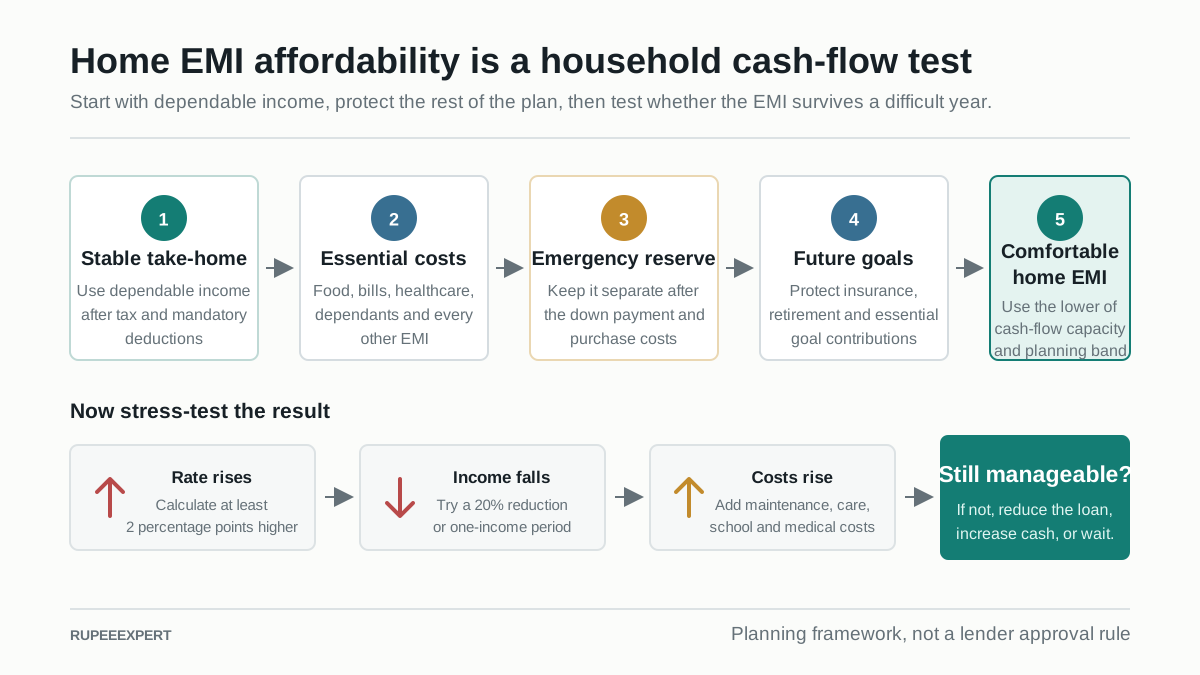
Comfortable home EMI = stable take-home pay - essential expenses - other EMIs - minimum goal contributions - home upkeep provision - safety margin
Essential expenses include food, utilities, transport, basic healthcare, insurance premiums, school costs, support for dependants, and other non-negotiable spending. Minimum goal contributions include the amount needed to keep retirement and important family goals on track.
The safety margin is deliberate unallocated cash. Without it, every repair, medical bill, fee increase, or family event becomes a new debt.
Compare the result with the planning bands above and use the lower figure. If the formula leaves ₹45,000 but 25% of stable take-home is ₹32,500, the lower amount gives the household more resilience.
Count all EMIs, not only the home loan
Before choosing the home EMI, list every fixed debt payment:
- Car and two-wheeler loans
- Personal and education loans
- Consumer-durable instalments
- Credit-card EMIs
- Loans against investments or gold
- Any loan for which you are a co-borrower and may have to pay
Suppose take-home pay is ₹1.5 lakh and the proposed home EMI is ₹40,000. The home EMI ratio is about 27%. That can appear reasonable. But a ₹15,000 car EMI and ₹8,000 education-loan EMI take total fixed debt payments to ₹63,000, or 42% of take-home pay, before normal living costs.
Paying off a short, expensive loan before taking a home loan can improve both cash flow and resilience. Do not borrow the down payment through a personal loan merely to make the home-loan application work.
Three example households
These examples are not approvals or recommendations. They show why salary alone cannot decide affordability.
| Household | Stable take-home | Other EMIs | Proposed home EMI | Home EMI share | Total EMI share | Interpretation |
|---|---|---|---|---|---|---|
| A | ₹1,00,000 | ₹0 | ₹25,000 | 25% | 25% | Conservative if essential costs and reserves are under control |
| B | ₹1,50,000 | ₹15,000 | ₹35,000 | 23% | 33% | Moderate; affordability depends on family costs and savings capacity |
| C | ₹2,00,000 | ₹20,000 | ₹70,000 | 35% | 45% | Stretched despite the higher salary; setbacks could quickly tighten cash flow |
Household C earns twice as much as Household A, but it has made a much larger fixed commitment. A higher income does not automatically make a higher percentage safe.
Now imagine Household B has two young children and one income varies with sales commissions. Its ₹35,000 home EMI may need to be reduced even though the table calls it moderate. Context changes the conclusion.
Protect the down payment and the emergency reserve separately
The down payment is not the only upfront cash required. A buyer may also need to fund stamp duty, registration, legal and technical checks, lender charges, brokerage, interiors, moving, utility deposits, repairs, and society or maintenance payments. These costs vary by property and location.
After paying them, keep a separate emergency fund. A common starting point is three to six months of essential expenses, including the proposed EMI. Consider more when:
- One person provides most of the household income
- Income is variable, contractual, or business-linked
- Jobs are in the same industry and exposed to the same risk
- There are dependants or ongoing medical costs
- The property may need unpredictable repairs
- A career break or parental leave is likely
Do not count an unused credit-card limit, an overdraft, or the ability to sell long-term investments as an emergency fund.
Stress-test a floating-rate loan
RBI directions require regulated lenders to consider repayment capacity and leave headroom for a possible rise in the benchmark rate when sanctioning EMI-based floating-rate personal loans. Borrowers must also be informed about the possible impact on EMI or tenure.
Your own test should be at least as serious.
Use the EMI calculator and run these scenarios:
- Interest rate rises by two percentage points. Check the new EMI at the same remaining tenure, not only the original payment.
- Take-home income falls by 20% for six months. Test whether essentials, insurance, and the EMI can still be paid.
- One income stops temporarily. For a two-income household, model parental leave, illness, relocation, or job loss.
- Essential costs rise. Add school fees, elder care, medical costs, commuting, and maintenance expected over the next few years.
- The property needs an unplanned repair. Check whether this would force credit-card or personal-loan debt.
If the loan works only in the most optimistic scenario, the house is too expensive for the present household budget.
For a floating-rate loan, a higher benchmark can lead to a higher EMI, longer tenure, or both, depending on the lender's policy and the option chosen. A tenure extension may keep the monthly payment steady while substantially increasing total interest and pushing the final payment closer to retirement.
Check retirement timing
A 25-year loan taken at age 42 may run until age 67. That does not automatically make it wrong, but the plan must answer:
- Will earned income continue throughout the tenure?
- Would the EMI require withdrawals from retirement assets?
- Are retirement contributions continuing while the loan is active?
- Can part-prepayments shorten the tenure without weakening other goals?
- Does the household still have adequate health and life insurance?
Do not solve an affordability problem only by extending the tenure. A longer tenure lowers today's EMI but usually increases total interest and keeps the obligation alive for longer.
Read the Key Facts Statement, not only the interest-rate advertisement
RBI requires regulated lenders to provide prospective retail term-loan borrowers with a Key Facts Statement in a standardised, understandable format. It includes the Annual Percentage Rate and an amortisation schedule.
Before accepting a home loan, compare:
- APR and total repayment
- Fixed, floating, or hybrid rate terms
- Benchmark and spread
- Reset frequency
- EMI and tenure changes when rates move
- Processing, legal, valuation, insurance, and administrative charges
- Part-prepayment and foreclosure terms
- Amortisation schedule
- Conditions attached to discounted rates
Ask the lender to explain anything unclear. Affordability depends on the actual loan contract, not the headline rate.
Joint income needs a one-income test
Including both partners' stable salaries can support a larger loan. But the property commitment often lasts longer than any current job arrangement.
Discuss possible career breaks, childcare, relocation, self-employment, elder care, illness, and different retirement dates before combining incomes. Then calculate:
- The normal two-income budget
- A temporary one-income budget
- The emergency reserve needed during the transition
The aim is not to pretend that one salary must fund the full loan forever. It is to avoid a situation where one ordinary life change immediately threatens the home.
Common mistakes to avoid
- Using CTC instead of take-home pay. CTC includes money that may never be available for monthly spending.
- Treating 30% as a guarantee. It is a reference point, not a substitute for a household budget.
- Ignoring other EMIs. Total fixed debt can be high even when the home EMI alone looks reasonable.
- Emptying savings for the down payment. Ownership begins with costs; it does not end with the purchase.
- Assuming income will only rise. Loans should survive periods when income is flat or temporarily lower.
- Checking only today's floating rate. A rate reset can change EMI, tenure, or both.
- Stopping retirement investing. A home is not a complete retirement plan and may not produce spendable income while you live in it.
- Choosing the longest tenure only to qualify. A lower EMI can hide much higher total interest and retirement risk.
- Counting tax benefits as affordability. Tax treatment can change and never turns a strained cash flow into a comfortable one.
A final decision checklist
Before paying a booking amount or signing a loan:
- Calculate on stable take-home pay.
- Keep the home EMI within a planning band that fits your household.
- Add every other EMI and fixed obligation.
- Preserve retirement and essential goal contributions.
- Keep a separate emergency fund after all purchase costs.
- Stress-test higher rates and lower income.
- Check when the loan ends relative to retirement.
- Read the KFS, APR, charges, reset terms, and amortisation schedule.
- Choose a smaller property or larger down payment if the cash flow remains tight.
- Revisit whether renting, buying, or building best fits the current stage of life.
Bottom line
There is no single correct home-EMI percentage. Around 30% of stable take-home pay is a useful affordability reference, while 25% or less creates more room for many households. But other debt, dependants, income stability, ownership costs, and long-term goals can make even a lower percentage uncomfortable.
Start with the household budget, preserve a genuine safety reserve, and test the loan against imperfect years. The best home loan is not the largest one a bank will approve. It is the one your life can carry without putting everything else on hold.
Frequently asked questions
What percentage of salary should go towards a home EMI?
There is no universal percentage. As a household planning guide, an EMI up to roughly 25% of stable take-home pay usually leaves more room, 25% to 30% needs a careful budget, and an EMI above 30% becomes increasingly sensitive to other debts, dependants, income risk, and ownership costs. These are planning bands, not lending rules.
Should I calculate home EMI affordability on gross salary or take-home pay?
Use stable take-home pay after tax and mandatory deductions because that is the money available to run the household. Do not count CTC benefits, uncertain bonuses, reimbursements, or hoped-for future increments as regular spendable income.
Do car loans and other EMIs change the affordable home EMI?
Yes. Add every fixed debt payment, including car, personal, education, consumer, and credit-card instalments. A home EMI that appears moderate on its own can become stretched when the household's total fixed debt is considered.
Can I include both partners' salaries?
Yes, when both incomes are stable and both people agree on the commitment. Also test whether the household could manage temporarily on one income, especially around parental leave, career breaks, health issues, or job changes.
What if a floating home-loan rate rises?
The lender may increase the EMI, extend the tenure, or use a combination permitted under its policy and the loan terms. Before borrowing, calculate the payment at a rate at least two percentage points higher and read the lender's Key Facts Statement and reset policy.
Should I take the full home-loan amount the bank approves?
Not automatically. Bank eligibility is a credit decision based on the lender's policy and view of repayment capacity. Your affordable amount should also preserve an emergency fund, insurance, retirement investing, other goals, and room for ordinary life.
How much emergency money should remain after the down payment?
Keep a separate emergency reserve after paying the down payment and purchase costs. A common starting point is three to six months of essential expenses including the proposed EMI, with more for irregular income, a sole earner, dependants, or uncertain employment.
Sources & further reading
Was this article helpful?